A screen with nowhere to hide
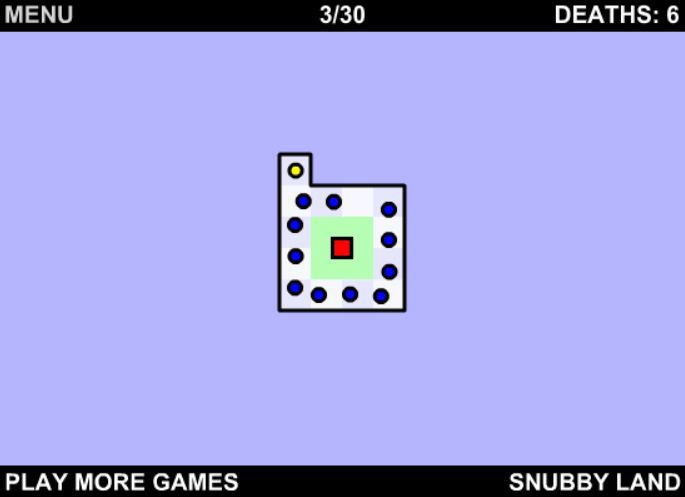
The World’s Hardest Game strips action down to colored shapes. The player is a red square. Blue circles move along fixed routes. Yellow coins must be collected. Green areas provide safety. There is no detailed character animation to soften a collision and no elaborate scenery to distract from a mistake. When the red square touches blue, the failure is immediate and visually undeniable.
This austerity makes the game feel honest even when it feels cruel. Every important object can be seen. Hazards follow patterns rather than improvising. The controls are limited to movement. The challenge does not come from remembering a large move set; it comes from understanding space while acting inside it. The screen presents all the evidence, then asks whether the player can remain calm enough to use it.
Observation is an active move
The natural impulse is to enter a room immediately. Movement feels like progress, while waiting can feel like hesitation. The game reverses that assumption. Standing inside a safe area and watching blue circles complete several cycles is often the most productive action available. Their speed, spacing, and phase relationships become visible only when the player stops trying to survive them.
Patience begins as data collection. Which gap remains open long enough to cross? Which hazards align every second cycle? Where can the square pause between patterns? A player who watches is not avoiding the problem. They are converting motion into a route. The game teaches that preparation can be part of execution, a lesson hidden by action games that reward constant forward pressure.
The route lives in small commitments
Once a pattern is understood, success still depends on dividing the room into manageable decisions. Crossing everything in one frantic motion invites correction too late. Strong attempts identify temporary islands: a corner, a narrow lane, or a point where several hazards have just passed. The player moves from one commitment to the next.
These pauses create a rhythm different from reflex alone. A short burst may require precision, but choosing when to begin matters more than moving quickly. The safest route is not always the shortest. Detours can preserve control by creating better entry angles or avoiding a crowded timing window. Patience becomes spatial judgment rather than mere slowness.
Coins complicate this route because reaching the green zone is not enough. The player must leave safety, touch exposed positions, and often cross the same hazard field again. Collection turns a direct escape into a planned sequence with a return journey. Greed is mandatory, so the real question becomes how to gather everything without letting the excitement of one successful crossing ruin the next.
Restarts make failure useful
Deaths arrive frequently, but the return to play is fast. That speed changes the emotional cost of experimentation. A player can test an opening, confirm that it fails, and try a different delay while the pattern remains fresh in memory. Each attempt functions like a note written directly onto the route.
The death counter adds pressure without changing the level. It records impatience, bad timing, and honest experimentation in the same number. Some players treat it as embarrassment; others treat it as proof of persistence. Either interpretation makes improvement visible. A room completed after dozens of failures feels different because the counter preserves the difficulty of learning it.
Sound contributes to the discipline. The music pushes forward while collision effects interrupt with blunt finality. After enough attempts, those cues mark a private tempo: move here, pause there, expect the reset. Players sometimes lower the volume to think, while others use the loop as a metronome. Either choice shows how concentration is constructed from the whole play environment, not only the visible maze. An attempt feels quiet because every decision arrives on time.
Precision is built before the hard moment
The game’s most demanding crossings appear to require sudden brilliance, but they are usually solved through preparation. The player learns how far the square moves during a tap, how momentum feels across diagonal input, and how close an edge can be approached safely. These tiny calibrations accumulate across easier movements.
By the time a narrow gap must be crossed, the hands possess knowledge that is difficult to explain verbally. The player does not calculate pixels. They recognize a duration and direction learned through repetition. Precision is therefore not an isolated talent. It is a memory built from hundreds of ordinary corrections, many of them made in rooms that once seemed impossible too.
Difficulty without disguise
The title is a boast and a joke, but it also sets a clear agreement. Players expect resistance. The game does not need to protect surprise difficulty or pretend every room welcomes casual completion. Its visual simplicity makes the challenge legible before the first movement. That transparency can make extreme difficulty easier to accept.
Fairness remains complicated. Knowing a pattern does not guarantee the dexterity to cross it, and some sequences demand repetition beyond what every player enjoys. Yet the game rarely confuses difficulty with randomness. Hazards become predictable, so frustration points back toward timing and control. The player may dislike the demand, but they can usually describe it.
Patience is not passive
Outside games, patience is often described as tolerating delay. The World’s Hardest Game offers a more active definition. Patience means watching closely, separating a large problem into smaller routes, resisting a bad opening, and repeating an action without allowing urgency to erase observation. It is a discipline of attention.
This definition explains why success produces such sharp relief. The player has not merely outlasted a timer. They have coordinated planning, memory, and movement under pressure. A completed room proves that panic can be replaced by rhythm. The blue circles still move exactly as before; what changes is the player’s relationship to them.
The game’s lasting lesson appears in the moment after a death. The red square returns to safety, the hazards continue their indifferent cycles, and the room offers no encouragement. The player can rush back into the same mistake or wait long enough to see a better beginning. Patience is that second choice: not surrender, not delay for its own sake, but the decision to understand before moving again.