Strategy contained on one screen
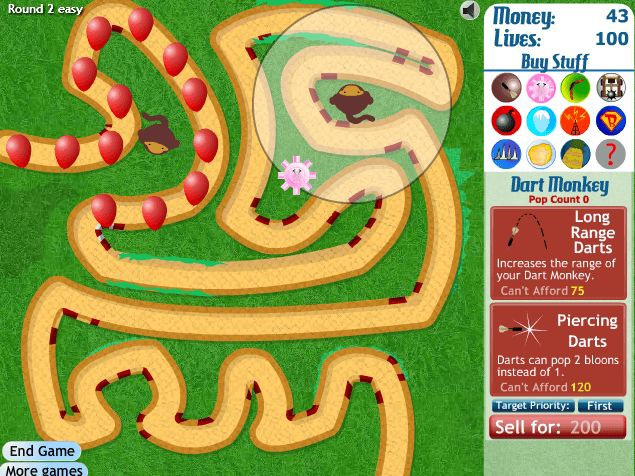
Tower defense turns a battlefield into something the player can survey. Enemies follow visible routes, defensive positions remain fixed, and the important economy sits close to the action. Unlike strategy games that require scrolling across continents or memorizing hidden production chains, a tower defense map often presents its argument in one frame. The player can see where danger begins, where it ends, and which spaces might influence the journey.
That containment suited the browser. Games appeared inside pages rather than taking over an entire machine, so a readable stage mattered. A player could arrive from a portal thumbnail and understand the broad situation before learning every tower. The map made the promise clear: build beside the route, observe the result, and improve the plan before the next wave.
The mouse was already enough
Browser audiences did not always have controllers, comfortable keyboards, or permission to install anything. They always had a pointer. Tower defense used that universal tool elegantly. Clicking a tower, choosing a position, and selecting an upgrade required no elaborate dexterity. The controls matched the same gestures used to navigate the surrounding web.
Mouse input also reinforced the role of commander. The player did not embody one soldier. They indicated priorities, arranged resources, and intervened from above. A deliberate click carried more meaning than constant motion. This made the genre approachable on office computers, school machines, laptops, and family desktops with wildly different setups.
Waves created natural chapters
The wave structure divided play into compact units. Preparation led to attack, attack produced evidence, and the pause afterward allowed repair. Each cycle had a beginning and end even when the full session lasted much longer. Players could measure progress through rounds rather than wait for a distant campaign conclusion.
This rhythm fitted uncertain schedules. A short break could hold several waves. A longer evening could stretch toward survival records or late upgrades. Some games allowed pauses between attacks, making interruption less destructive than it would be in continuous action. The genre respected the fragmented attention of browser play without requiring shallow systems.
Economy gave every quiet moment tension. Coins spent now could secure a weak bend, while coins saved might unlock a tower capable of reshaping the entire map. The interface made that argument persistent by placing prices beside visible threats. Players learned to read money as delayed action: each unspent amount represented both risk in the present and possibility in the next wave.
Watching was part of thinking
Once a wave began, much of the pleasure came from observation. Towers rotated, projectiles crossed, enemies clustered, and a carefully prepared route performed under pressure. Watching was not empty downtime. It revealed attack coverage, targeting behavior, bottlenecks, and timing problems. The defense became a live diagram of the player’s assumptions.
This visibility made strategy shareable. A spectator could understand why one lane failed or why a particular tower dominated a corner. Advice emerged naturally because decisions remained on screen. Tower defense worked well around one computer: the person with the mouse made purchases, while everyone nearby argued about where the next tower belonged.
Complexity could arrive one icon at a time
The genre supported gradual teaching. An early map might introduce one basic tower and slow enemies. New towers could then add splash damage, slowing, long range, resource generation, or specialized targeting. Each icon represented a distinct answer to a problem the player had already seen.
Because towers remained visible after purchase, their roles did not need constant explanation. The player watched them work and formed expectations. Later levels could combine familiar units in unfamiliar layouts. Depth grew from relationships between known tools rather than from an expanding control scheme. This made substantial strategy possible inside games that still welcomed a first click.
Map design could tell stories without dialogue. A winding forest road suggested ambush, a castle gate concentrated desperation, and multiple entrances forced divided attention. Terrain created emotional shape through mechanics. Long approaches offered confidence before enemies reached a crowded final turn; short paths made every purchase feel urgent. By rearranging routes and buildable spaces, designers changed the mood of defense before introducing one new unit. The battlefield stayed still, but the player's priorities kept moving.
Portals rewarded endless variation
Game portals needed titles that could attract repeat visits, support sequels, and generate recognizable screenshots. Tower defense offered all three. New maps changed placement values. New enemies challenged established defenses. New tower themes transformed the surface while preserving understandable rules. A creator could expand a successful foundation without discarding the audience’s knowledge.
The genre also supported many tones. Balloons and monkeys could make defense cheerful. Medieval armies could emphasize siege. Aliens, robots, insects, and abstract shapes could travel the same fundamental route while producing different fantasies. Portal grids filled with variations because the structure was durable and the theme was flexible.
Failure explained the next purchase
When enemies escaped, they usually showed where the defense broke. A fast group outran slow attacks. Armored units survived damage designed for crowds. Flying enemies ignored a ground-focused plan. The defeat contained a shopping list. Players returned to the build phase with a reason to choose differently.
This feedback made repetition productive. Replaying a map was not merely repeating inputs more accurately; it was testing a revised theory. Move one tower, invest earlier in upgrades, diversify damage, or save for a powerful answer. The browser encouraged immediate restarts, and tower defense gave those restarts strategic purpose.
A genre built for the space between
Tower defense flourished online because every layer matched the environment around it. The pointer handled control. One map organized information. Waves created stopping points. Bright icons sold the premise in thumbnails. Visible systems rewarded spectators. Expandable content supported sequels and long sessions without making entry difficult.
None of those qualities belong exclusively to browsers, and tower defense has succeeded on many platforms. Yet the genre’s browser era reveals a rare harmony between form and setting. It could be paused when work returned, understood by someone standing behind the chair, and resumed with one more wave. Strategy did not need a manual, a weekend, or a dedicated machine. It needed a path, a few coins, and enough empty ground for the player to imagine where resistance should begin.