A quiz that lies about being a quiz
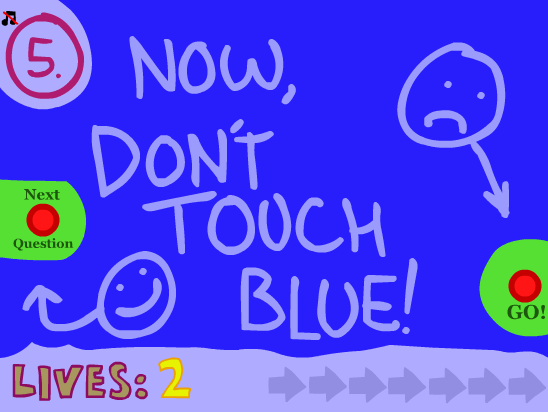
The Impossible Quiz presents four answers, a question number, and the visual language of a familiar multiple-choice test. That resemblance lasts only long enough to become a trap. The game is not interested in measuring stored knowledge. It measures attention, suspicion, memory, timing, and willingness to treat the screen as an object rather than a neutral container. A word may hide the answer. A button may move. The correct response may be somewhere outside the four boxes. By borrowing the authority of a quiz and immediately abusing it, the game turns a rigid format into a comedy stage.
The title warns players, but not in a useful way. “Impossible” could mean obscure trivia or extreme difficulty. Instead, impossibility becomes a permission slip for mischief. The player enters expecting questions and receives riddles, visual gags, reflex challenges, and instructions designed to be misunderstood. This unpredictability is not decoration around the game. It is the central mechanic. Every screen asks the same hidden question: what kind of problem is this one pretending to be?
The interface joins the joke
Most interfaces promise stability. Buttons remain buttons, labels explain actions, and empty space stays irrelevant. The Impossible Quiz withdraws that promise. Anything visible can participate in the solution, including the question number, punctuation, cursor, or arrangement of answers. The player must stop reading the screen as a form and start reading it as a scene.
That shift creates a distinctive kind of alertness. A conventional quiz rewards quick recognition, but this game punishes automatic behavior. The obvious answer may exist only to consume a life. Wording must be inspected literally, then figuratively, then as a possible instruction about the interface itself. The game teaches distrust through repetition until hesitation becomes a skill. Players hover, test, and search before committing. The cursor becomes a probe.
That uncertainty keeps every ordinary button suspicious.
Wrong answers are punchlines
Failure in The Impossible Quiz often completes the joke. A tempting answer is funny because so many players choose it. The redirection between expectation and consequence resembles a prank with carefully prepared timing. Losing a life may frustrate, but it also reveals how the setup worked. The player becomes both target and audience.
This design depends on speed. A wrong click produces an immediate response and another attempt remains close. If failure required a long reload or erased too much progress, the humor would curdle into punishment. The limited-life system adds pressure, yet familiarity makes earlier questions faster on each run. Repetition turns the opening sequence into a rehearsed routine, allowing players to recover their position while proving they have learned the game’s private logic.
Memory becomes a performance
Later progress requires remembering answers that may never become logically sensible. A player knows to choose a particular absurd option because experience has transformed nonsense into instruction. This gives successful runs a theatrical quality. To a newcomer, an expert seems clairvoyant, clicking strange places with perfect confidence. To the expert, every action recalls an earlier surprise.
The game therefore produces knowledge that is highly specific and socially valuable. Friends trade solutions, warn one another about traps, and take turns attempting timed sections. Watching someone encounter a question for the first time can be as entertaining as solving it. The quiz becomes a collection of reactions. Its culture lives not only in answers but in the moment before another person discovers why the obvious choice is wrong.
Fairness was never the agreement
Some questions are genuinely clever. Others depend on arbitrary memory, dated references, or tricks that offer little chance of deduction. Judged as a traditional puzzle collection, the game is inconsistent. Yet traditional fairness was never its full agreement with the player. The consistent promise is surprise. The game reserves the right to change genres, reinterpret language, and demand knowledge it did not teach.
That freedom gives the experience personality, but it also marks its limits. Mischief works best when players feel invited to laugh at the deception. Repeated arbitrariness can make progress depend on endurance rather than insight. The tension between delightful trick and cheap trap is part of the game’s identity. It constantly approaches the line, crosses it, and challenges players to decide whether the next joke is worth another attempt.
A product of Flash culture
The Impossible Quiz fits the browser era because it treats rapid sharing as part of play. Its questions are compact stories that can be described, quoted, or demonstrated. A single strange solution is enough to make someone send the link. The deliberately rough drawings and compressed sounds add to the feeling that a mischievous creator is speaking directly through the screen.
Flash also supported the game’s mixture of text, animation, sound, cursor interaction, and sudden timing challenges inside one lightweight stage. It could behave like a quiz for ten seconds, become an arcade test, then return to a visual pun. That flexibility encouraged creators to treat genre as material. The result feels less like a polished examination and more like an escalating conversation with someone determined to change the rules.
What rule-breaking taught players
The Impossible Quiz trained a generation to question interface assumptions. It taught players that labels may be literal objects, that negative space may contain information, and that instructions can describe their own wording. These lessons appear in later puzzle games that use windows, menus, save files, or control conventions as part of the challenge. The Quiz was not alone in exploring those ideas, but its popularity made them widely legible.
Its deeper achievement is tonal. The game gives rule-breaking a voice: smug, energetic, childish, inventive, and occasionally infuriating. Players do not continue because they trust it. They continue because the betrayal has become the relationship. Each solved question feels like temporarily outsmarting the prankster behind the curtain.
The Impossible Quiz remains memorable because it understood that a browser screen could be more than a frame. It could be evidence, obstacle, stage, and joke. The game borrowed a format associated with correct answers, then made correctness unstable. In doing so, it created a different test, still asking whether players can abandon habit, survive embarrassment, remember nonsense, and click again after the rules have already changed.