A battlefield anyone can read
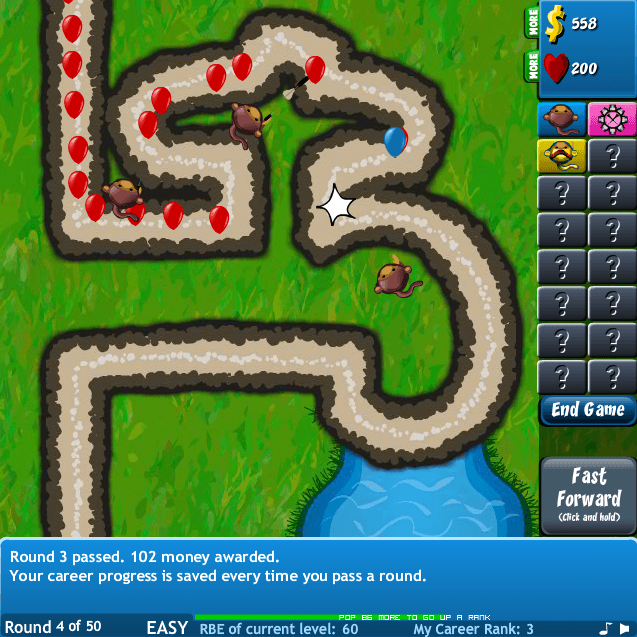
Bloons Tower Defence explains itself before the first balloon reaches the first bend. A path crosses the screen. Bright shapes enter at one end and threaten to leave through the other. A monkey placed beside that path throws darts. The rules are visible, the danger is legible, and the player understands the job without a paragraph of instruction. That clarity is the foundation of the series. Protect the exit. Put the right tool near the right stretch of road. Watch the plan meet reality.
The balloons are a brilliant choice of enemy because their state can be read through color and motion. They do not need health bars, armor diagrams, or threatening animations. A pop is immediate feedback. Faster colors create urgency; layered balloons reveal that one successful hit may uncover another problem underneath. Even a crowded wave remains playful rather than grim. The cheerful presentation lowers the intimidation of strategy while leaving room for decisions. Players can make mistakes without feeling as though they have failed to understand a war game. They see what slipped through.
Placement turns space into strategy
Every tower purchase is also a claim about geography. A long straightaway favors range. A tight bend gives a monkey several chances to attack the same target. Intersections create valuable zones where one tower can cover multiple segments. The map is not scenery; it is the economy expressed as space. Good placement stretches every coin, while careless placement leaves expensive power watching an empty corner. Because the consequences remain visible, players learn to inspect routes before spending.
This spatial lesson grows naturally. Early rounds tolerate rough plans, giving the player time to notice which towers attack often and which need better positioning. Later waves expose gaps that were always present. A defense may handle slow groups but fail when speed compresses the time available. Another may pop outer layers efficiently yet struggle with what emerges afterward. The game does not announce these weaknesses through a report. It sends a wave that makes them impossible to ignore.
Upgrades create personal attachment
A tower begins as a simple purchase, but upgrades turn it into a small project. Increasing range, attack speed, pierce, or special abilities changes how that tower participates in the defense. The player remembers which monkey saved an earlier round and wants to improve it again. What began as a disposable unit gains a history. This attachment makes upgrade decisions more emotional than a spreadsheet would suggest.
The temptation to overinvest is part of the design. One powerful tower feels reassuring, yet several modest towers may cover the map more reliably. Saving for an exciting upgrade can leave the current round dangerously thin. Spending immediately may solve today while delaying the tool needed tomorrow. Bloons gives these tradeoffs friendly faces, but the underlying tension is classic strategy: concentration against coverage, present safety against future strength, and specialized answers against flexible preparation.
The round counter is a promise
Rounds divide pressure into understandable chapters. Survive one wave and the game pauses long enough for relief, evaluation, and shopping. The next number becomes a promise that the same plan will be tested more severely. This rhythm creates the famous “one more round” feeling. Stopping after a success seems premature because the defense is finally working. Stopping after a failure feels equally difficult because the weakness now appears solvable.
The structure also turns observation into pleasure. Once towers are placed, the player watches a system perform. Darts cross paths, explosions catch groups, and carefully chosen coverage produces a chain of pops. The satisfaction is partly strategic and partly theatrical. A successful defense resembles a machine the player designed, yet enough uncertainty remains to keep every wave tense. Watching is not passive because each result informs the next intervention.
Sequels that expanded without erasing
The early Bloons Tower Defence games grew by adding maps, tower types, balloon properties, and upgrade possibilities, but the central sentence remained intact: place defenses beside a path and stop the balloons. That continuity gave sequels a strong advantage. Returning players could recognize the grammar immediately, then discover new vocabulary through play. Complexity arrived as an extension of fluency rather than a replacement for it.
This is difficult to achieve. Sequels often mistake more content for deeper design, burying the original appeal beneath menus and exceptions. Bloons generally expanded outward from readable interactions. A new tower suggested a role. A new balloon property created a reason to diversify. A new map altered the value of range and placement. Additions mattered because they changed decisions on the board, not merely because they increased a feature list.
Failure becomes a diagram
When balloons escape, they trace the exact shape of a bad assumption. Perhaps the defense concentrated damage too late on the path. Perhaps fast balloons crossed a weak stretch before slow towers could respond. Perhaps the player spent everything on power and ignored coverage. The loss is animated analysis. Watching the leak provides more useful information than a generic defeat screen could.
Fast restarts protect that learning. The player can replay the map with one changed placement and compare results. Strategy becomes an experiment conducted in short, visible cycles. This accessibility is why Bloons can welcome children and still occupy experienced players. The rules invite intuition, while optimization offers a much deeper pursuit. Both audiences look at the same path but ask different questions.
Brightness is not simplicity
Bloons demonstrates how presentation can make complexity approachable without removing it. Monkeys, balloons, and cheerful colors promise playfulness. Underneath them sits a system of timing, geometry, economy, probability, and escalating pressure. The theme does not apologize for strategy or disguise it. It gives strategy a vocabulary that feels safe to explore.
That balance explains the series’ endurance. Players remember popping sounds and expressive towers, but they return for the moment a plan stabilizes under pressure. Each successful round confirms dozens of small judgments: where to build, when to upgrade, what to save, and which weakness deserves attention first. The genius of Bloons is not that it makes strategy easy. It makes strategy visible. Once the player can see a decision working, the next round becomes almost impossible to resist.