A title that announces a remix
Super Mario 63 makes its intentions clear before the first jump. Its name sits between Super Mario 64 and an imagined alternative, suggesting something recognizable but unofficial. The game does not pretend to be a lost Nintendo release. It presents itself as a fan’s enormous response to several beloved Mario adventures.
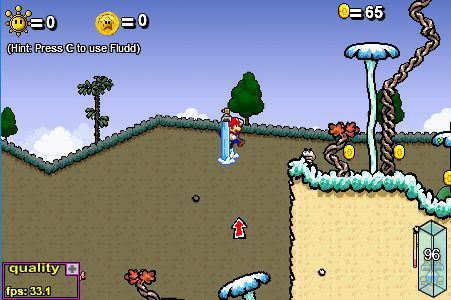
Created by Runouw, the project translates ideas associated with three-dimensional console games into a two-dimensional Flash platformer. Peach’s Castle, Shine Sprites, Star Coins, power caps, and FLUDD abilities meet inside one browser window. The combination is less a careful sequel than an enthusiastic conversation across eras.
Three dimensions folded into two
Adapting a spatial exploration game to a side view requires more than flattening the graphics. In three dimensions, players can circle landmarks and approach objectives from many angles. A two-dimensional stage must create exploration through vertical routes, hidden passages, branching rooms, and movement that rewards curiosity.
Super Mario 63 builds levels with height and breadth. Mario can climb, spin, dive, hover, and search beyond the obvious path. The screen may scroll toward a platform that looks decorative, only to reveal another route or collectible. Space feels layered even when movement remains on a plane.
Movement carries the personality
Mario games are remembered through motion as much as imagery. A fan project can display familiar blocks and enemies, but it feels convincing only when running and jumping produce the expected spirit. Super Mario 63 treats movement as its central argument.
The controls allow momentum, aerial adjustment, spins, ground pounds, and specialized FLUDD actions. These options create expressive routes through stages. A player can recover from a weak jump, chase a high ledge, or combine abilities in ways that feel discovered rather than prescribed.
Not every interaction matches an official game, and that difference is part of the appeal. The physics form their own dialect. Familiar verbs have been reconstructed by observation and preference, producing a Mario who is recognizable but specific to this project. Learning that variation turns imitation into a new skill.
FLUDD changes the shape of a jump
The water-powered device from Super Mario Sunshine is a particularly ambitious addition. In a side-scrolling game, hovering extends the horizontal and vertical possibilities of every platform arrangement. Rocket and turbo functions introduce further ways to read the terrain.
FLUDD makes movement less binary. Missing a ledge is not always final; stored water can become a correction. A distant collectible may require a launch sequence rather than one jump. The player manages both trajectory and a limited resource, adding planning to the platforming rhythm.
Collectibles turn scale into purpose
An ambitious world risks becoming empty unless exploration produces meaningful discoveries. Shine Sprites and Star Coins give the player reasons to inspect corners, revisit stages, and master difficult routes. Their placement converts large levels into networks of intentions.
Collecting is not merely completion bookkeeping. A visible prize changes how nearby terrain is interpreted. Platforms become a possible sequence; an unusual wall suggests a hidden entrance. The object provides a question, and movement supplies the answer.
Progress through the castle connects those local discoveries to the broader game. Each reward belongs to one stage but contributes to access elsewhere. The structure makes the fan project feel sustained rather than episodic. Dozens of small triumphs accumulate into a tour of everything its creator wanted to build.
The level designer shares authorship
Super Mario 63 extends its ambition beyond a fixed campaign with a level designer. Players can arrange terrain, enemies, objects, and challenges, then represent their stages through shareable data. The game becomes both an adventure and a toolkit.
This feature changes the relationship between fan and franchise. Runouw first interprets Mario through a personal project; players then interpret that project through their own levels. Admiration produces a chain of authorship rather than ending at consumption.
Rough edges reveal the human scale
A project this large inevitably contains uneven moments. Certain stages sprawl, controls can feel idiosyncratic, and the mixture of visual sources does not always disappear into one seamless style. Judged against a professional console production, those seams are easy to identify.
Yet the seams also reveal effort. Every course, animation, collectible, and menu exists because a small-scale creator kept expanding the project’s boundaries. The mismatch between available resources and attempted scope becomes emotionally important. Players can sense a person reaching beyond what the format seems prepared to hold.
Fan work as critical reading
Super Mario 63 demonstrates that fandom is not passive repetition. Selecting elements from different games, translating them into Flash, and connecting them through new levels requires interpretation. The creator must decide which qualities are essential and which can change.
Those decisions form an argument about Mario. Movement should be playful. Worlds should reward detours. Collectibles should open possibilities. A central hub should make separate adventures feel connected. The fan game communicates these beliefs through systems instead of an essay.
It also captures a historical moment when browser tools let ambitious amateurs distribute work globally without manufacturing discs or securing shelf space. A project inspired by commercial games could become a formative game for players who encountered it freely after school.
The browser window stretches
The enduring wonder of Super Mario 63 is the contrast between container and contents. It loads where tiny puzzles and five-minute diversions also lived, yet offers a hub, long campaign, movement system, collectibles, secrets, and construction tools. The browser window seems too small for its appetite.
That excess is precisely what makes the game memorable. It is not satisfied with proving that Mario can function in Flash. It wants to build a version broad enough to explore, master, modify, and discuss. Each added system risks disorder, but also enlarges the tribute.
Fan games are sometimes described by what they lack: authorization, budget, official assets, or professional teams. Super Mario 63 is better understood through what it possesses: attention, technical curiosity, and freedom to combine influences with joyful disregard for product planning.
Its greatest achievement is not perfect resemblance. It is making admiration playable. The game takes memories formed in other worlds and rebuilds them as a new place with its own routes and rhythms. A player enters expecting imitation and finds evidence that love, when given tools and time, can become a form of design.