A menu full of bad ideas
Henry Stickmin games reduce dramatic situations to a row of tempting options. A bank wall, prison cell, museum, or government facility becomes the setting for an apparently simple decision. Choose a tool. Pick a direction. Trust an object that clearly does not belong in the scene. Traditional adventure games train players to search for the sensible solution, but Henry’s menus make nonsense irresistible. The stranger the icon, the harder it is to ignore.
This changes the emotional meaning of choice. Players are not only asking which option will work. They are predicting which failure will be funniest. A teleporter might solve the problem, place Henry somewhere disastrous, or expose a completely different joke. The menu becomes a comedy lineup in which every button promises a performance. Success remains an objective, but curiosity constantly competes with efficiency.
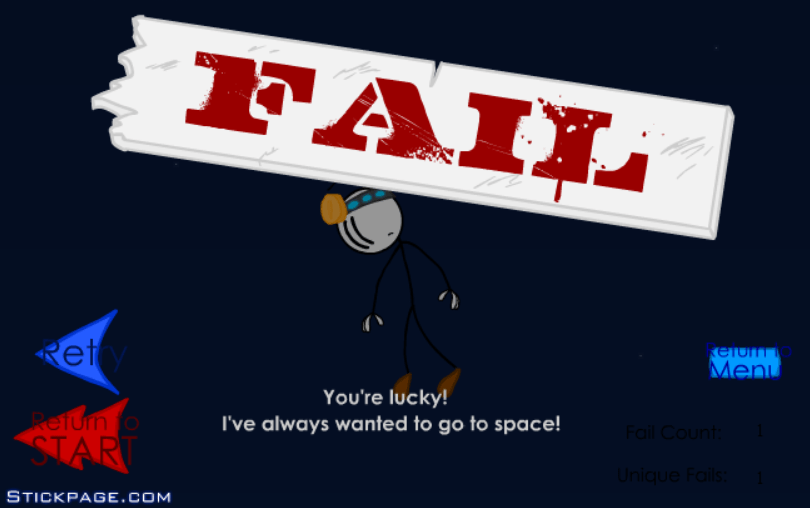
Failure gets the expensive animation
Many games spend their most elaborate production on victory. Henry Stickmin frequently gives that privilege to mistakes. A bad choice can trigger a full action sequence, visual parody, sudden transformation, or carefully timed anticlimax. The player loses, yet receives the richest reward available: a scene they could not have seen by behaving rationally.
That inversion creates trust. Once players learn that failure contains authored material, they stop treating wrong answers as wasted time. They deliberately explore. Completion no longer means finding one route to the end; it means exhausting the decision tree and collecting every ridiculous consequence. The fail screen becomes a doorway rather than a wall. Its short caption often adds a final joke, reframing what just happened before the player jumps back to the choice.
Comedy through borrowed language
The series speaks fluently in references to games, cartoons, action movies, internet culture, and familiar interface conventions. A tool may arrive from another fictional universe with its rules partially intact. A dramatic pose may mimic a famous scene only to collapse under Henry’s incompetence. These references work because the stick-figure art leaves room for recognition. One silhouette, sound cue, or animation rhythm can establish the source before the joke changes direction.
Borrowing also makes each menu unpredictable. An ordinary object follows physical logic, while a referenced object may follow the logic of another game entirely. Players must consider not only what a tool does, but what genre has temporarily entered the scene. The resulting collisions give Henry Stickmin its restless energy. Every choice can rewrite the rules because every choice may import a different world.
The pause before the punchline
Interactive comedy depends on timing, but the player controls part of that timing. A choice screen creates a pause in which possibilities gather. The player points, hesitates, and commits. Animation then takes control, delivering setup and consequence at a fixed rhythm. This handoff is crucial. The player feels responsible for initiating the joke even though every frame was authored in advance.
Quick resets preserve the rhythm. After a failure, returning to the decision takes only a moment. The scene remains fresh enough for another branch to feel like an alternate punchline to the same setup. Longer delays would separate the options and weaken comparison. Henry Stickmin allows players to sample variations rapidly, noticing how one premise can support slapstick, parody, surprise, or an unexpectedly successful plan.
A protagonist built to absorb chaos
Henry’s simple design makes him unusually flexible. He can become thief, prisoner, spy, action hero, fool, or victim without requiring a complicated explanation. His face communicates panic and confidence with minimal marks. Because he begins as an empty stick figure, costumes, props, and exaggerated movements can transform him instantly while keeping his identity readable.
His personality emerges through decisions and consequences rather than dialogue. Henry is ambitious enough to attempt impossible plans, lucky enough to survive some of them, and foolish enough to make every menu plausible. Players shape the version of Henry they see. One route presents competence, another greed, another accidental heroism. The character feels consistent because every version shares the same willingness to try.
Branches become stories worth comparing
Branching narrative often promises moral weight or radically different worlds. Henry Stickmin uses branching for density. Routes are compact, distinct, and easy to revisit. A successful ending provides closure while making unexplored choices more visible. Players can discuss paths without needing to summarize hours of plot. “What happened when you chose the drill?” is enough to begin a conversation.
This structure suited the social web perfectly. Friends could recommend one option, hide a punchline, or watch someone make the obvious mistake. Videos and classroom demonstrations extended the audience beyond the person clicking. Reactions became part of the entertainment. The game supplied the trap; another player supplied the anticipation of knowing exactly when it would spring.
Completion means seeing everything
The series quietly changes what mastery looks like. Mechanical skill matters during occasional timed sequences, but the larger challenge is curiosity. Players learn to inspect menus, replay branches, locate hidden interactions, and resist the urge to stop after reaching an ending. A checklist of failures is not evidence of incompetence. It is evidence that the player has seen the work.
This philosophy respects the labor inside optional scenes. Animations that would be missed in a success-focused game become central attractions. The creator can invest in an absurd branch because the audience is motivated to seek it. Failure transforms from negative space around the correct route into a gallery of authored possibilities.
The collection screen reinforces that invitation by turning missed disasters into visible gaps. An unknown branch is not merely unfinished business; it is an unseen performance waiting behind a familiar button. This makes replay feel purposeful without pretending that every choice changes the universe. The scale stays honest. Players are collecting comic scenes, learning the shape of the tree, and discovering how many different ways one problem can collapse spectacularly.
Henry Stickmin made failure the best choice by removing its usual shame and filling it with generosity. A wrong click delivers character, reference, animation, and surprise. The player laughs, learns nothing useful, and eagerly returns to make another terrible decision. In a medium obsessed with winning, Henry’s greatest trick is making the road away from victory feel like the part nobody should miss.