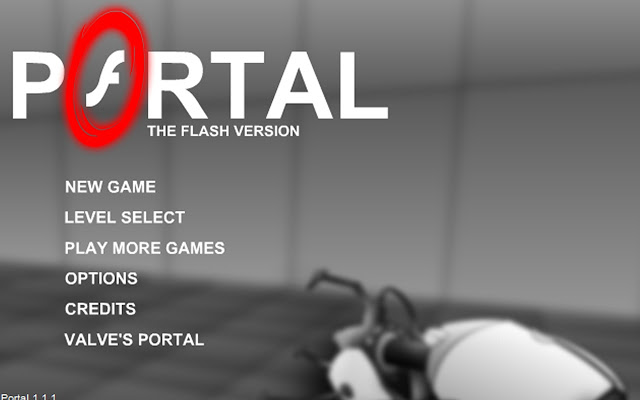
Translating a room, not shrinking it
Adapting Portal for the browser could have produced a crude summary: familiar colors, a portal gun, and jokes borrowed from a larger game. The Flash Version takes a more interesting route. It asks which parts of Portal’s design survive when a three-dimensional room becomes a side-view chamber. The answer is not everything. Perspective, free aiming, and physical exploration change immediately. Yet the pleasure of connecting distant surfaces and reconsidering paths between them remains.
This is translation rather than reduction. A good translation does not preserve every word; it preserves relationships and effects. The Flash Version rebuilds spatial reasoning around platforms, walls, switches, hazards, and momentum that can be understood from one fixed viewpoint. It feels recognizable because the player still solves movement by changing connectivity, not because the screen resembles a smaller screenshot of the original.
Two dimensions clarify the grammar
The side view removes uncertainty about depth. Every relevant surface lies on the same plane, so the player can read a chamber like a diagram. This clarity lets puzzles concentrate on sequence. Which portal should be placed first? Where must momentum begin? What object needs to cross a barrier before the player follows? The room exposes its pieces, but not their correct order.
Fixed perspective also makes portal relationships visually elegant. An entrance on the floor and an exit on the wall describe a transformation immediately. The player sees position and orientation together. Complex movement can be planned before execution because the entire route often fits on screen. The challenge moves away from camera control and toward constructing a logical sentence with two connected openings.
The visual restraint supports that mental model. Clean chambers separate usable walls, dangerous fields, moving objects, and exits without requiring realistic architecture. Color works as instruction, and repeated shapes create expectations that later rooms can challenge. Because the player is already tracking two portal locations, momentum, and switches, the artwork wisely spends its detail on information that changes the solution.
Momentum becomes visible
Portal’s famous movement principle is that speed entering one portal carries through the other. In two dimensions, this rule becomes almost graphical. A fall creates vertical speed; the exit redirects that speed into a horizontal launch. The player can watch the trajectory as a line across the chamber.
This visibility supports experimentation. A failed launch reveals whether the fall was too short, the exit angle was wrong, or the destination was blocked. The next attempt can change one variable. Physics remains exciting, but it also behaves like evidence. The player learns to see height as stored possibility and empty space as a runway.
The portal gun edits level design
Most platform games ask players to master routes authored in advance. The portal gun allows limited editing. Walls remain fixed, but the connection between surfaces becomes negotiable. A dead end can become an entrance. A ceiling can become a floor approached from another direction. The player does not destroy the level; they rewrite its adjacency.
That power is constrained by surfaces that accept portals and by hazards that punish careless placement. Constraint keeps the tool from becoming a universal shortcut. The puzzle designer chooses the vocabulary, while the player arranges it into a route. This balance gives every successful solution a feeling of authorship without surrendering structure.
Controls reveal another careful translation. Keyboard movement supplies the dependable language of a platformer, while aiming portals introduces a separate layer of intention. The player alternates between inhabiting the character and editing the room. When those modes cooperate, a sequence feels fluid: move, place, fall, emerge, land. When they conflict, the puzzle exposes exactly which action needs more preparation.
Objects turn travel into choreography
Companion objects complicate the clean fantasy of moving oneself. A box may need to activate a switch, interrupt a hazard, or travel through portals in a different order. The player must choreograph two routes whose timing and destination overlap. Carrying an object changes jumps and makes narrow movement more deliberate.
These puzzles reveal the portal gun as a logistics tool. Connectivity is not only escape; it is transport. The player begins thinking about what a chamber requires in its final state. A switch needs weight, a door needs power, and the protagonist needs access. Solving means arranging those conditions rather than merely reaching the far side.
Failure stays close to the idea
Browser puzzle games benefit from quick correction, and The Flash Version keeps failed experiments compact. A missed jump, misplaced portal, or badly timed crossing can be attempted again without rebuilding an enormous sequence. This protects curiosity. Players remain willing to test unusual arrangements because the cost of being wrong is limited.
The chamber structure reinforces that focus. Each room introduces or combines a manageable set of ideas. Completion closes one argument before the next begins. Difficulty can rise through layering rather than scale: a familiar momentum trick joins a switch, object, hazard, or restricted surface. The player carries understanding forward even when the scenery remains spare.
Humor survives in smaller gestures too, providing brief relief between chambers without interrupting the concentration that a difficult spatial sequence demands from players. The laboratory feels controlled, but never lifeless or mute.
Adaptation creates its own identity
The Flash Version cannot reproduce the atmosphere, performance, or navigational freedom of a three-dimensional production, and it does not need to. Its strengths come from the new medium: immediate browser access, compact rooms, crisp side-view readability, and a platforming rhythm distinct from first-person movement. What appears to be compromise becomes design material.
Fan adaptations are often judged by resemblance, but resemblance is the least interesting measure here. The game succeeds when players stop comparing screenshots and begin solving its rooms on their own terms. It proves that a strong mechanic can travel when creators understand its principle rather than copying its surface.
The small miracle is not that Portal somehow fits inside Flash. It is that the adaptation identifies a portable idea: space can be made surprising when two surfaces become neighbors. Everything else is rebuilt around that sentence. The result honors its inspiration while demonstrating independent craft, turning a technically smaller game into a clear argument about what Portal was always asking players to imagine.