Starting with an unlikely athlete
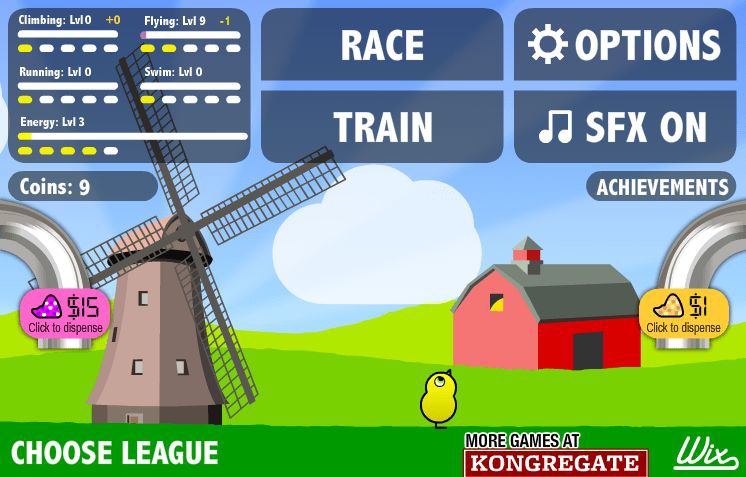
Duck Life begins with a wonderfully modest hero. The duck is small, plainly drawn, and far from championship form. That vulnerability gives every later achievement meaning. Rather than handing the player a powerful character and asking for mastery, the game offers potential and asks for care. Running speed, swimming skill, flying ability, and stamina are not abstract numbers attached to an action figure. They belong to a creature the player feeds, trains, colors, and gradually recognizes as their own competitor.
The premise works because it combines comedy with sincerity. A racing duck is ridiculous, yet the game treats improvement seriously enough for the player to invest. Training sessions have clear rules. Food has value. Equipment and appearance create ownership. The humor opens the door, but the progression keeps it open. By the first race, the player is no longer controlling any duck. They are testing the result of decisions made across many small sessions.
Practice becomes the main event
Most sports stories compress practice into a montage because repetition is less dramatic than competition. Duck Life makes the montage playable. Training is not a menu where points are assigned; it is a sequence of compact challenges that demand attention. Running asks for timing, flying asks for control, and swimming introduces its own hazards and rhythm. Statistics rise because the player performs the activity rather than merely selecting it.
This creates a useful double progression. The duck improves numerically while the player improves mechanically. A higher level makes later attempts easier, but familiarity also produces better reactions and cleaner routes. The game rarely needs to explain this partnership. Players feel it when a training challenge that once seemed frantic becomes manageable. The number confirms growth, while the hands provide independent evidence.
Repetition with visible purpose
Grinding can feel empty when the reward is distant or difficult to understand. Duck Life avoids that problem by making growth visible everywhere. Levels increase after training. Energy changes how long the duck can compete. Races that once ended badly become winnable. New opponents and areas provide milestones close enough to imagine. Every repetition points toward a recognizable test.
The sessions are also short, which keeps failure lightweight. Missing an obstacle does not erase an evening of work. It ends one attempt and makes another immediately tempting. Coins collected during practice add a second purpose, turning imperfect runs into useful progress. Even when the player fails to set a personal record, the duck may still become stronger or earn resources. The game is generous without removing effort.
The race as a report card
Races are exciting partly because they reduce control. Training asks the player to perform; competition asks them to watch preparation unfold. The duck runs, flies, or swims according to the abilities already developed. This temporary loss of direct control creates suspense. The player sees every earlier decision expressed as speed, endurance, and consistency.
A loss is therefore unusually readable. If the duck begins well but fades, energy needs attention. If an opponent dominates one section, the corresponding skill needs work. The race becomes a report card without grades or criticism. It shows the shape of weakness and sends the player back to training with a clear objective. Victory feels earned because the decisive work occurred before the starting line.
Caring through customization
Customization may appear separate from progression, but it strengthens the emotional loop. Choosing colors, hats, or other visual details turns the duck into a continuing character rather than a replaceable unit. The options are simple, yet simplicity is enough. Players remember the champion they designed because appearance connects repeated sessions into one personal story.
Food performs a similar function. Energy management is a system, but feeding the duck reads as care. The player is not only purchasing capacity; they are preparing a small athlete for competition. Duck Life constantly translates numbers into friendly actions. Statistics become training. Currency becomes food and equipment. A build becomes a recognizable creature. That translation gives routine decisions warmth.
Sequels as new seasons
The Duck Life sequels expanded the formula with different events, settings, progression systems, and presentation, but each return preserved the pleasure of beginning again. A new game feels like a new season with another inexperienced duck and another ladder of competitions. Familiar training provides comfort while altered challenges prevent the routine from becoming automatic.
This structure is unusually suited to sequels because improvement is the narrative. Resetting progress does not simply remove power; it restores the central fantasy of development. Players return to witness the curve from clumsy beginner to capable champion. New mechanics matter when they add another dimension to that curve, giving practice a fresh texture or races a different demand.
Why the montage still works
Duck Life understands that growth is most satisfying when it can be measured at several scales. One good jump improves a training run. One training run increases a level. Several levels change a race. Several victories open the next part of the world. The player always has a nearby objective and a larger horizon. Progress never exists only as a bar moving in a menu.
The design also respects uneven attention. A player can train for a few minutes and leave with something accomplished. A longer session can move through upgrades, food, customization, and multiple races. There is no need to remember an elaborate plot or control scheme after time away. The duck waits in a state that explains itself.
That memory is why the series feels more intimate than its simple artwork suggests. Progress is never delivered by an anonymous timer. It passes through familiar exercises, close losses, collected coins, and small improvements the player can name. The victory preserves the entire route, not only the result.
The joy of the training montage comes from turning repetition into authorship. The champion at the end reflects hundreds of tiny choices, corrections, and improved attempts. Duck Life makes those moments visible without making them heavy. Its races are playful, its hero is absurd, and its systems are approachable, but the emotional result is real. The player sees a once-ordinary duck cross the finish line and remembers exactly how it learned to get there.