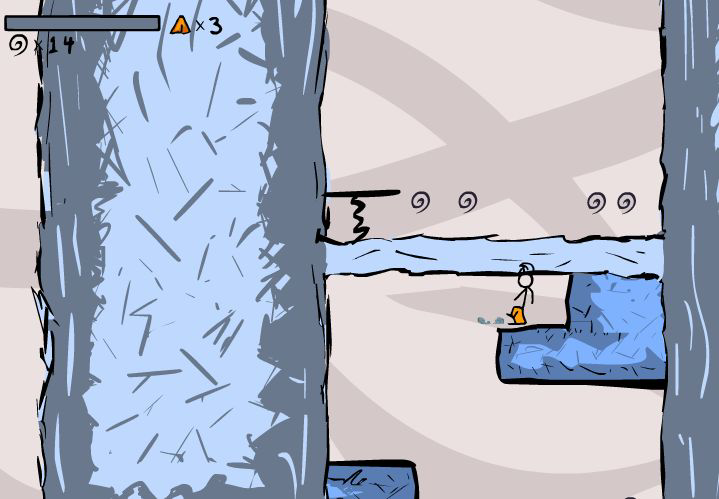
A run with personality
Fancy Pants does not move like a neutral platform-game avatar. He leans, accelerates, skids, flips, and lets his scribbled trousers trail behind him. The animation communicates speed before the level demands it. Even crossing an empty stretch feels expressive because the character appears to enjoy motion.
That personality changes the player’s goal. Reaching the exit matters, but moving beautifully becomes a parallel ambition. A jump can be technically successful while feeling clumsy. A clean sequence through a curve, spring, and wall feels rewarding even when it collects nothing. The game invites players to judge traversal by rhythm as well as outcome.
Curves replace ordinary floors
Many platformers build levels from flat ledges and right angles. Fancy Pants uses slopes, bowls, loops, and rolling terrain that convert horizontal speed into vertical possibility. The ground is not merely where the character stands. It is an instrument that stores and redirects momentum.
A downhill run prepares the next leap. A curved wall can lift the character toward a hidden route. A bowl becomes disappointing when entered too slowly and exhilarating when crossed with enough speed to reach the opposite lip. Players learn to read terrain in phrases. The shape before a jump matters as much as the platform after it.
Momentum asks for commitment
Responsive controls are often associated with stopping immediately, but Fancy Pants finds pleasure in controlled commitment. Speed takes time to build and affects what comes next. Reversing direction or correcting a bad approach carries visible cost. The character has weight without feeling sluggish.
This creates a conversation between planning and improvisation. A player may intend to follow the main route, notice an opening above, and use existing momentum to chase it. The attempt may produce a secret, a stylish recovery, or a collision that breaks the flow. Because movement contains consequence, each adjustment feels authored rather than automatic.
Enemies are placed inside this movement language rather than above it. A creature can interrupt a careless sprint, provide a bounce, or force the player to choose between speed and caution. Combat remains secondary because stopping for every encounter would damage the larger rhythm. The most satisfying interactions resolve quickly, allowing danger to become another beat in the route instead of a separate mode.
Animation teaches without text
Fancy Pants’s body explains the control model. His forward lean indicates acceleration. Long strides sell top speed. A skid shows that direction has changed faster than momentum. Wall interactions, flips, and landings reveal when the game has recognized a move. The player reads mechanics through pose.
This visual feedback is especially important at high speed. A small icon or written prompt would arrive too late. Animation keeps information attached to the character, exactly where the eye is already focused. Style and usability become the same work. The famous line art is memorable because every line participates in control.
Flow includes optional mistakes
The best runs are not always the safest. Decorative spirals, hard-to-reach collectibles, and upper routes tempt players away from direct completion. Pursuing them can interrupt momentum, yet the possibility gives movement direction. The player decides when elegance should yield to curiosity.
Failure remains light enough to encourage those detours. Missing a collectible does not invalidate the route; it creates a reason to turn around or replay. An awkward landing can become the beginning of a new sequence. The game protects flow by allowing mistakes to bend a run rather than always ending it.
Sound completes the rhythm
Movement becomes musical when actions produce a recognizable cadence. Footsteps, springs, impacts, and collectible sounds punctuate the animation. Their timing confirms speed and contact while giving a successful route an audible pattern. The player can hear when a sequence is clean.
Silence and restraint matter too. Constant effects would flatten the differences between running, jumping, and landing. By letting individual sounds mark events, the game gives space to anticipation. A launch has a setup, an airborne interval, and a landing that resolves the phrase. The level becomes a score performed through input.
Hand-drawn worlds invite play
The visual world resembles a sketchbook that discovered motion. Platforms, doors, creatures, and backgrounds share an informal line quality. This keeps the environment light even when precision matters. The world feels available for experimentation rather than protected behind polished realism.
Hand-drawn style also supports exaggeration. A curve can be built for pleasure instead of architecture. A character can stretch into a pose that communicates more than accurate anatomy would. The environment obeys the logic of animation, where shapes exist partly to prepare the next movement.
Doors divide the world without making it feel rigid. Entering one can reveal a compact challenge, an unexpected character, or a route whose scale differs from the open level outside. These transitions create rests between longer movement phrases. They also reward players who resist the obvious exit and inspect the edges, treating architecture as a collection of invitations rather than a single corridor.
Traversal as the real destination
Fancy Pants stages adventures with doors, enemies, collectibles, and goals, but its deepest achievement lies between those landmarks. The transition from standing to running, from slope to jump, and from wall to open air remains satisfying after the route is known. Knowledge does not empty the level; it makes smoother performance possible.
This is why replay feels natural. The player is not only repeating a solved course. They are interpreting it again, choosing where to preserve speed, where to detour, and how to recover when the intended line breaks. Familiar terrain becomes more expressive as control improves.
Mastery arrives when intention and terrain begin agreeing before the jump. At that point, the player stops forcing progress and starts cooperating with shapes that once seemed decorative, finding speed already waiting inside every generous curve on the scrolling page ahead.
The Fancy Pants Adventure made movement feel like music by giving it phrasing. Acceleration is an opening measure. Curves change pitch. Springs create accents. Landings resolve tension. The player supplies tempo through confidence and correction. Long after individual objectives blur, the remembered pleasure is simple: a hand-drawn figure leaning forward, a hill falling away beneath him, and the sense that the level is about to sing.