A shop inherited before breakfast
Papa’s Pizzeria begins by placing responsibility on someone who did not ask for it. The shop needs to open, customers are arriving, and every station demands attention. The premise is lightly comic, but the work quickly becomes real. Orders must be heard, pizzas assembled, ovens watched, slices cut, and results delivered to people with visible preferences.
The restaurant feels cozy because its scale remains understandable. One counter, one kitchen, one oven area, and one cutting board form the entire workplace. The player learns every corner. Pressure comes from movement between familiar stations rather than from navigating a confusing environment. Repetition turns the shop into a room the player can mentally inhabit.
Every order is a small promise
An order ticket describes more than ingredients. It records how toppings should be distributed, how long the pizza should bake, and how the finished pie should be divided. Accepting the ticket creates a promise that all those details will survive several stages of work.
That promise produces memory pressure. The ticket remains available, but time continues while the player checks it. Experienced players begin holding patterns in mind: pepperoni on one side, mushrooms across the whole pie, six slices, a particular baking point. Fluency means looking less often without becoming careless. The customer’s request gradually becomes a shape rather than a list.
Craft is visible on the surface
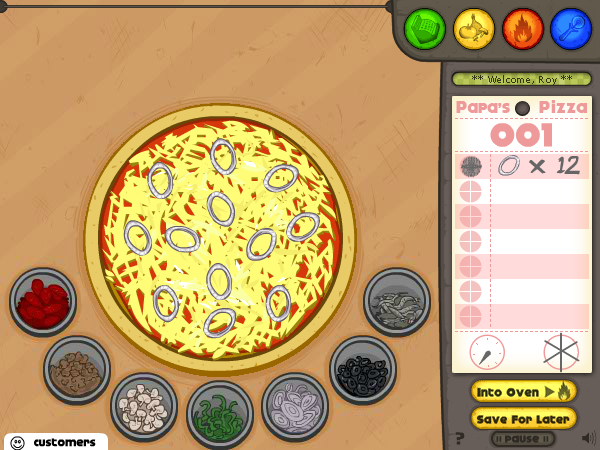
Placing toppings makes quality spatial. A pizza can contain the correct quantity and still look uneven. Ingredients clustered near the center or scattered carelessly toward the crust reveal haste. The game judges distribution because the visual result communicates attention.
This turns assembly into a calm microtask inside a busy shift. Each topping is dragged and positioned deliberately. The player can create symmetry, preserve separate halves, and anticipate slice boundaries. There is pleasure in making the pizza readable before it reaches the oven. The finished surface becomes evidence of care.
The oven creates invisible debt
Once a pizza enters the oven, it temporarily leaves direct attention while continuing to change. This is where cozy work becomes pressure. A new customer may arrive, another pizza may need toppings, and the baking meter keeps advancing. Every task accepted at the counter creates future responsibility elsewhere.
Strong play depends on remembering that invisible debt. The player develops a mental clock, checking the oven between actions and learning which tasks fit safely inside a baking interval. A beautifully arranged pizza can still be ruined by neglect. The oven insists that quality is not one perfect action but coordination across time.
Cutting reveals the whole shift
The cutting station appears simple after ordering, topping, and baking, yet it can undo careful work. Slices must match the requested number and pass through the intended arrangement. A slightly misplaced line changes several portions at once. The final task compresses the entire order into geometry.
Cutting also provides closure. The pizza stops being a project moving between stations and becomes a completed object ready for judgment. Those decisive lines feel satisfying because no further correction is possible. The player commits, sends the order forward, and waits for the customer’s response.
Customers turn scores into relationships
Customers differ in patience and preference, giving repeated orders recognizable personalities. A score is attached to a face that has waited, watched, and will return another day. This makes feedback feel social even when it is numerical. A low topping score is not an abstract deduction; it is disappointment delivered across the counter.
Regular customers also support long-term learning. The player begins anticipating familiar orders and recognizing which visitors demand faster service or unusual arrangements. Repetition becomes intimacy. The restaurant’s community is built from tickets, expressions, and repeated chances to do better for someone remembered.
Pressure stays readable
Papa’s Pizzeria creates stress without filling the screen with chaos. Orders line up visibly. Stations separate types of work. Meters show progress. Mistakes can usually be traced to one decision: taking too many orders, forgetting the oven, placing toppings poorly, or cutting without enough care.
This readability keeps pressure from becoming hostility. The player may fall behind, but the path toward improvement is clear. Faster movement helps less than better sequencing. The game rewards a composed routine: accept work, prepare it accurately, check ongoing processes, and finish one promise before its customer loses patience.
Upgrades measure confidence
Between shifts, earned tips can improve the restaurant with equipment and small comforts. These purchases matter because they translate yesterday’s accuracy into tomorrow’s breathing room. A bell makes the oven easier to monitor; decorations can soften a customer’s wait. Progress does not erase the core routine. It gives the player better support for performing it well, like a cook gradually arranging a workstation around habits already learned.
The upgrades also prevent efficiency from feeling purely mechanical. Money comes from people who appreciated the result, then returns to the room where future customers will be served. That loop makes improvement communal. The player is not collecting abstract power. They are reinvesting praise into a modest business, one practical object at a time, until the pizzeria visibly reflects many successful shifts.
That visible accumulation matters because restaurant work begins again every morning. The dining room remembers what the daily schedule cannot: dozens of careful pizzas, recovered mistakes, and satisfied regulars. Each new object quietly says that repetition has produced a history, not merely a higher score worth keeping.
Why the routine feels like home
Management games often grow by adding complexity, but the emotional appeal of Papa’s Pizzeria begins with repetition. The same stations receive different demands. Familiar actions become smoother, leaving more attention for timing and presentation. Improvement appears as calm inside a shift that once felt impossible.
The kitchen becomes cozy because effort leaves visible traces. Toppings align more evenly. Oven checks happen at the right moment. Cuts meet in the center. Customers leave happier. The player does not decorate a home; they build familiarity through competent care.
Papa’s Pizzeria understands that comfort and pressure are not opposites. A meaningful routine needs enough demand to make mastery visible. The ringing counter creates urgency, while the repeated craft of preparing food creates stability. Between those forces sits the player, turning tickets into meals and a borrowed workplace into somewhere they know how to run.