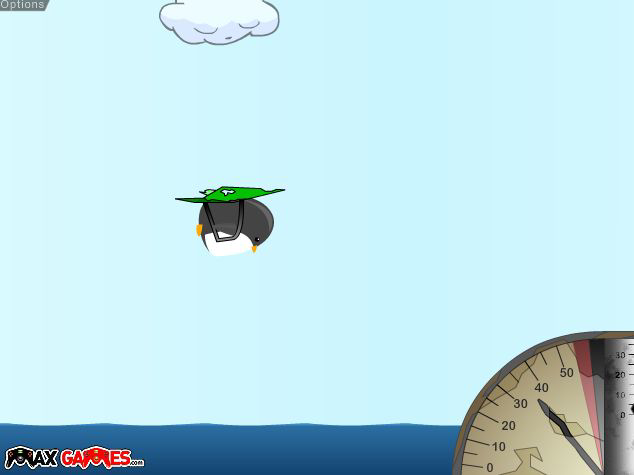
The insult on the screen
Learn to Fly opens with a penguin discovering an inconvenient claim: penguins cannot fly. Instead of accepting biology, the little bird takes the statement personally. That reaction establishes the game’s comic engine and its emotional logic. The mission is absurd, the equipment is improvised, and the first launch is destined to end in cold water. None of that makes the goal feel meaningless.
The joke works because stubbornness becomes a virtue. The penguin does not need a prophecy, a villain, or a threatened kingdom. A dismissive fact is enough. By framing flight as an answer to doubt, the game turns every short attempt into a tiny act of defiance. The player is invited to believe before there is any evidence that belief is sensible.
Failure arrives with a receipt
The first flights barely deserve the name. A ramp provides speed, gravity takes over, and the penguin splashes down moments later. Yet the results screen refuses to call the attempt wasted. Distance, altitude, speed, airtime, and money convert a disappointing arc into useful information.
This accounting changes the meaning of failure. Falling is not a verdict; it is a measurement. Perhaps the launch angle was too steep, the glider lost momentum, or fuel was spent at the wrong moment. The numbers preserve what the player learned and award resources for trying. Even a clumsy flight carries something forward.
The ramp becomes a laboratory
Every launch repeats the same basic ritual, which makes small changes easy to notice. The slope, sky, and water remain stable while equipment and technique evolve. That consistency turns the ramp into an informal laboratory. Change one variable, watch the trajectory, and decide what the result suggests.
The player learns through touch rather than instruction. A low angle may preserve speed; a high one may gain altitude at a terrible cost. Boost can rescue a fading glide or disappear uselessly during a poor ascent. The game’s physics are approachable enough for intuition, yet expressive enough that timing matters.
Because each experiment lasts only moments, curiosity is cheap. A strange idea does not threaten an hour of progress. The player can test it immediately, laugh at the splash, and adjust. Optimism thrives in that short loop because disappointment never has time to harden into resignation.
Purchases make hope mechanical
Money earned from flights buys ramps, gliders, rockets, fuel, and improvements. Each purchase is a promise expressed as hardware. A new wing suggests longer distance. A stronger launcher imagines greater speed before the next run even begins. The shop is exciting because every item contains a future attempt.
Upgrades also make ambition legible. At first, the penguin is effectively falling with accessories. Later, the machine becomes capable of sustained travel, controlled climbs, and dramatic acceleration. The growing apparatus mirrors the player’s changing expectations. Goals that once seemed ridiculous become routine, and new ridiculous goals take their place.
Crucially, progress never becomes automatic. Better equipment expands possibility, but the player must still manage angle, momentum, and fuel. Hope receives tools rather than guarantees. The next flight can still go badly, which keeps success connected to judgment instead of shopping alone.
Medals redraw the horizon
Achievements give the player targets beyond simply traveling farther. Reaching a certain altitude, maintaining speed, staying airborne, or covering a milestone distance asks for different kinds of flights. One perfect strategy cannot satisfy every challenge.
The horizon therefore keeps moving. Each completed objective reveals another scale of possibility. What began as a desperate hop becomes an engineering campaign. The penguin’s confidence feels earned because the player has watched impossible thresholds become ordinary measurements one by one.
Comedy protects sincerity
The premise remains funny even as the upgrades become powerful. A determined penguin straps machinery to its body, launches from an increasingly unreasonable ramp, and repeatedly lands in the sea. Exaggerated animations and brisk results keep the spectacle light.
That comedy protects the game’s sincerity. A serious speech about believing in yourself could feel heavy; a penguin with a rocket can express the same idea without embarrassment. The player is allowed to care because the game is willing to laugh. Failure becomes slapstick, while perseverance quietly retains its dignity.
Mastery changes the weather
Early flights feel ruled by gravity. The player watches speed vanish and water approach, hoping to stretch a few extra meters from a weak glide. Later attempts feel active. Boost, angle, and upgraded equipment let the player shape the journey rather than merely endure it.
This transition is the game’s most satisfying transformation. The sky itself has not changed, but the player’s relationship to it has. Empty space that once represented inevitable descent becomes room for decisions. Distance becomes something constructed through a sequence of small corrections.
Mastery is visible without becoming mysterious. The same gauges and controls remain on screen from the beginning. Success comes from understanding familiar elements more deeply and combining them with accumulated resources. The game makes competence feel like a sunrise: gradual in the moment, unmistakable when compared with where the day began.
Optimism as a daily practice
Learn to Fly does not define optimism as expecting immediate success. Its penguin expects to fall and walks back to the ramp anyway. Optimism is the habit of treating an imperfect result as material for another attempt.
The structure supports that habit at every level. Statistics turn crashes into evidence. Money turns effort into equipment. Achievements turn distant hopes into named steps. Short flights make experimentation safe. Humor keeps setbacks from acquiring too much weight. Every system points toward the next launch.
Eventually, the claim about flight matters less than the response it inspired. The penguin’s victory is not only reaching some final distance. It is building a practice around refusal: observe, improve, try again. The player participates in that practice until persistence no longer feels heroic. It simply feels like what tomorrow is for.
That is why the game remains encouraging long after its novelty should fade. It offers no fantasy of effortless achievement. Instead, it celebrates measurable inches, awkward prototypes, and hopeful repetitions. The ocean is always waiting, but so is the ramp. Between them lies one more chance to discover that yesterday’s impossible journey has become today’s starting point.