A block, a hole, and no excuses
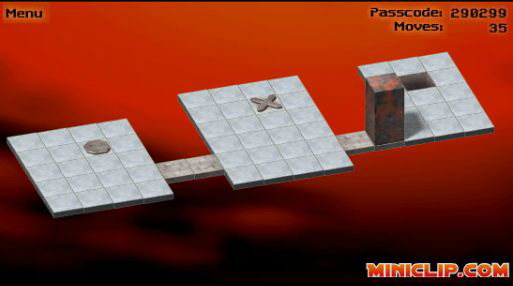
Bloxorz explains itself almost immediately. A rectangular block rests on a tiled platform, and somewhere nearby waits a square hole. The objective is to stand the block upright over that opening so it can fall through. Arrow keys tip the block from face to face. Everything important is visible before the first move.
That clarity is not simplicity in disguise. The block occupies one square while standing and two while lying down, so every movement changes both position and footprint. A safe tile for one orientation may be useless for another. From a tiny collection of facts, the game produces puzzles that demand planning, memory, and spatial imagination.
Orientation is the real location
Most grid puzzles define position with a coordinate. Bloxorz requires a third piece of information: posture. The block can stand upright, lie along one axis, or lie along the other. Two states may touch the same tile while leading to entirely different futures.
This makes navigation unusually rich. Moving toward the goal is not always progress because arrival in the wrong orientation can make the final drop impossible. A useful route may first carry the block away from the hole, simply to rotate its posture through a wider loop. Distance becomes less important than readiness.
Players gradually stop seeing the block as an object being pushed. They begin seeing a state being transformed. Each arrow changes a compact equation made from location and orientation. That mental shift is the gateway to the game’s deeper puzzles, and Bloxorz teaches it without introducing a single technical term.
The board teaches through edges
Falling off the platform is the game’s most common punishment, but an edge is also a precise teacher. It reveals which rotations require space and which apparent shortcuts cannot work. Because failure happens instantly, the lesson remains attached to the move that caused it.
The restart is equally immediate. There is little ceremony between hypothesis and correction. A player can replay the opening sequence quickly, preserve what worked, and change the doubtful step. This rhythm turns the board into a sketchpad where routes are drawn with motion and erased by gravity.
Switches complicate without corrupting
Later stages introduce switches, bridges, fragile tiles, and divided blocks. These additions expand the puzzle vocabulary, but they remain connected to the original physical rule. A switch cares whether the block touches it, lies across it, or presses it while upright. A fragile tile cannot support the block’s full standing weight.
The distinction matters. New mechanics do not feel like exceptions pasted onto the game. They ask the player to pay closer attention to footprint, orientation, and sequence. The central idea becomes more expressive instead of being replaced.
Even the split-block mechanism preserves spatial reasoning. Two cubes can move independently and later reunite, creating questions about coordination and assembly. The puzzle briefly changes grammar, yet its language remains tiles, adjacency, and controlled transformation. Complexity grows from the same roots the player learned on the opening board.
Every move spends future space
A strong Bloxorz solution is rarely a string of locally safe choices. Each movement changes which rotations will be possible later. Crossing a bridge may leave too little room to align with the next passage. Pressing a switch may open a route while positioning the block badly for using it.
This gives every move a shadow. The visible action solves the present square; its orientation creates or removes future options. Good planning means imagining that shadow before committing. The player mentally rolls the block across tiles that have not yet been reached.
The best levels exploit this without becoming arbitrary. They show the destination early, sometimes tantalizingly close, while forcing a route that prepares the correct final posture. The eventual solution feels surprising and inevitable at once. After discovering it, the player can trace why every detour was necessary.
Sound makes logic physical
Bloxorz is visually restrained, but its sound gives weight to thought. Each rotation lands with a blunt impact. Falling produces a mechanical collapse. Switches answer contact with clear feedback. The puzzle may exist on an abstract grid, yet the block never feels like a weightless cursor.
The presentation also knows when to stay quiet. There is no constant celebration for ordinary progress. The game leaves space for concentration, then lets a successful drop provide the punctuation. Restraint gives the final fall more satisfaction than a screen full of effects could provide.
Elegance can still be difficult
Bloxorz demonstrates that accessibility and difficulty are not opposites. Anyone can understand what an arrow key does. The challenge comes from combining transparent actions across a shaped board. Nothing prevents a newcomer from beginning, and nothing prevents later stages from becoming formidable.
This is constructive difficulty. The player does not need faster reflexes, hidden knowledge, or luck. They need a more accurate model of the block. When stuck, the productive question is clear: which assumption about orientation, timing, or space has been overlooked?
Because the rules are dependable, insight feels personal. The game does not hand over a stronger block after repeated failure. The object remains unchanged; the mind directing it improves. A once impossible level becomes easy because the player can finally see the route folded inside it.
The pleasure of a closed system
Many games promise freedom by continually adding possibilities. Bloxorz creates freedom inside boundaries. The board is finite, the moves are discrete, and the goal is fixed. Those limits allow the player to reason with confidence. Every legal state belongs to a system that can, in principle, be understood.
That transition is the lasting appeal of Bloxorz. Its one perfect rule is not merely that a block rolls across tiles. It is that form determines possibility. The game explores that truth with discipline, discovering new consequences without losing clarity. A block, a platform, and a hole become enough material for an entire education in looking ahead.
The final drop is satisfying because it contains the whole solution. The upright block pauses above the only square that can receive it, then disappears. All the earlier rotations, detours, and corrected mistakes are compressed into that clean motion. For a moment, the puzzle has no loose ends. Geometry and intention occupy exactly the same space.