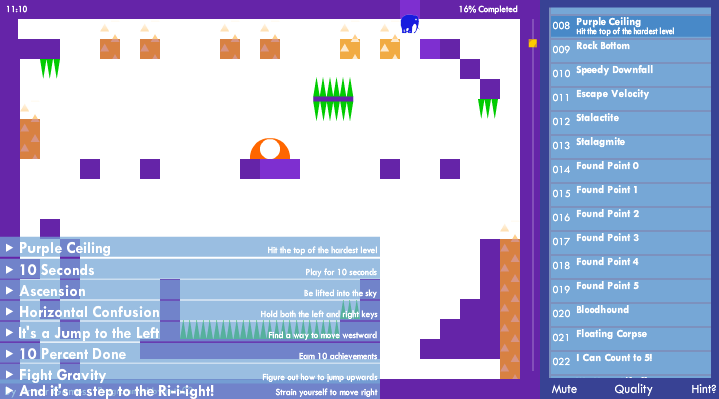
The day the rectangle went quiet
When browser support for Flash ended, countless game pages remained online but lost the software that made their central rectangle respond. Screenshots, descriptions, and comments survived around an empty space. The files often still existed; the ordinary path into them did not. Preservation suddenly became visible to players who had assumed a webpage would keep working simply because its address remained.
Ruffle approaches that silence through emulation. Instead of asking browsers to run the discontinued Flash Player, it interprets Flash content through new software designed for systems. The goal sounds simple: open an SWF and make it behave. The work requires rebuilding expectations accumulated across years of language features, graphics, audio, input, and browser interaction.
Emulation is translation under pressure
A Flash game contains instructions written for a particular runtime. Ruffle must understand those instructions and produce equivalent behavior inside an environment with different rules. This resembles translation, but the text is active. A mistranslated sentence may sound awkward; a mistranslated collision, timer, or variable may stop a game completely.
Compatibility therefore has layers. ActionScript language features must behave correctly. Built-in APIs must provide the methods games expect. Rendering needs to reproduce shapes, masks, filters, text, and animation. Audio and input must remain synchronized. External requests may point toward services that no longer exist. One title can work perfectly while another exposes a missing edge case nobody had encountered before.
Two generations of ActionScript
Flash content spans major changes in its programming model. Earlier games commonly used ActionScript 1 or 2 on the original virtual machine, while later projects increasingly relied on ActionScript 3 and a newer virtual machine. Ruffle tracks compatibility across both language behavior and APIs because “supporting ActionScript” is not one finished switch.
This distinction explains why archives avoid absolute promises. A game may load, reach its menu, and then fail when one uncommon feature appears. Another may be fully playable despite belonging to a less complete compatibility category because it uses only well-supported features. Real testing remains important. Compatibility percentages describe an enormous landscape; individual games travel only particular paths through it.
One script can reopen a shelf
For website owners, Ruffle’s web package can be added to a page and used to create a player for an SWF file. It can also replace legacy embedded Flash elements on existing sites. That relatively small integration step is transformative. Visitors press play in a modern browser without installing the original plugin.
The simplicity at the surface depends on complexity underneath. WebAssembly allows substantial emulator logic to run in the browser, while Rust provides the core implementation. JavaScript connects the player to the page. The result feels ordinary by design: a game appears where a game should be. Successful preservation often looks less dramatic than the engineering that enables it.
Performance adds another challenge. Games were authored for machines, frame rates, and browsers that behaved differently from today’s devices. Emulation must balance accuracy with responsiveness across phones, laptops, and desktops. A title that appears lightweight may depend on unusual rendering or scripting patterns. Smooth play is therefore not merely raw speed; it is agreement between old expectations and new resources.
Safety changes the invitation
The original Flash plugin developed a reputation shaped partly by security problems and constant update warnings. Modern browsers eventually removed the plugin model that supported it. Ruffle does not revive that exact architecture. Its project emphasizes Rust and WebAssembly, using the guarantees of those technologies to avoid the old player’s security pitfalls.
This matters culturally as well as technically. A preserved game should not require visitors to install abandoned software or weaken browser protections. The safest path is also the most welcoming one: open a page, use a contained player, and leave without changing the computer. Access becomes compatible with contemporary expectations rather than dependent on nostalgia for obsolete infrastructure.
Imperfection is useful evidence
Ruffle is improving, but not every title behaves exactly as it did in Adobe Flash Player. Graphical inaccuracies, incomplete APIs, timing differences, and missing network dependencies can remain. Treating those gaps honestly protects both players and the historical record. A broken feature is not proof that the original game was defective; it may identify work the emulator still needs.
Bug reports turn individual failures into shared progress. A strange menu, invisible object, or stalled script can expose an assumption that deserves implementation. Preservation becomes collaborative testing across a library too large for one team to anticipate. Players contribute by noticing differences, archivists contribute files and context, and developers translate discoveries into code.
Good presentation still matters after compatibility is solved. Archives need accurate titles, controls, file hosting, and enough context to explain what visitors are opening. A player alone can reproduce behavior, but curation turns behavior into an approachable collection. Search, artwork, descriptions, and related titles help people move from one recovered artifact toward a broader understanding of the era.
Open source keeps the door inspectable
Ruffle is free and open source, which means its preservation mechanism can be studied, improved, packaged, and adapted rather than controlled by one discontinued product. Volunteers contribute to the emulator, web player, extension, desktop application, documentation, and testing. The project’s continuity rests on a community that can see how the door works.
Openness does not guarantee permanence, but it distributes the ability to maintain it. Archives can self-host the web package. Users can run desktop builds. Developers can inspect missing behavior instead of waiting for a vendor whose priorities are unknown. For cultural software, that inspectability is a form of resilience.
A second life is not a reset
Ruffle cannot restore every external server, advertisement network, leaderboard, or social context that once surrounded a game. It does something narrower and more valuable: it gives the playable artifact another environment in which to respond. The second life carries traces of loss, yet it preserves the conversation between input and consequence.
Pressing an arrow key and seeing an old character move is a small event with large implications. Code written for a vanished runtime is being interpreted again. Art, sound, timing, and rules return as behavior rather than documentation. The game does not become new, and the past does not become complete. But the quiet rectangle speaks, and another player can answer.